The Former Refectory Hall
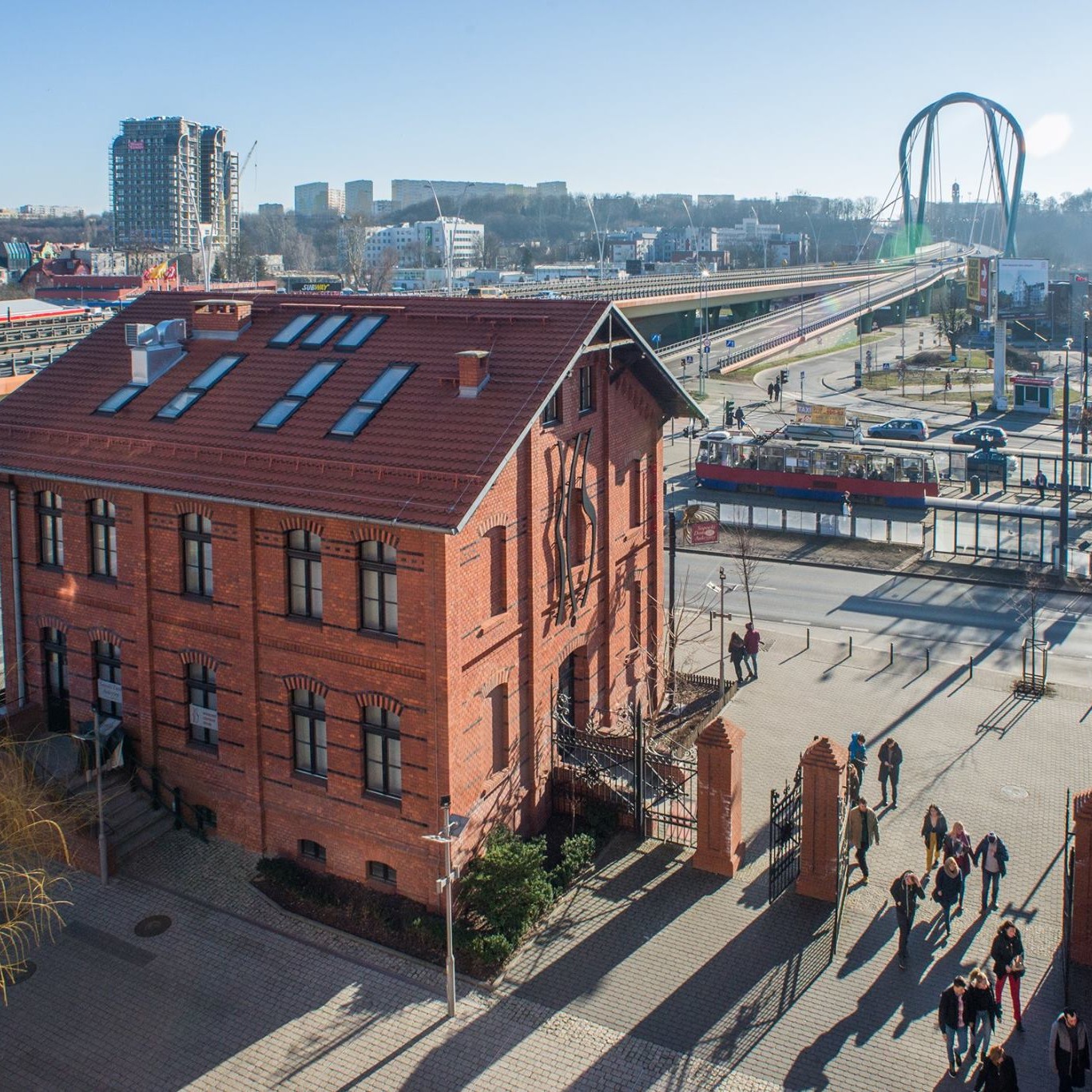
The building at 4 Gdańska Street is the headquarters of the Leon Wyczółkowski District Museum in Bydgoszcz. This structure is tightly interwoven with the history of the city. Evolving from a monastery to a hospital, an administrative building, and finally a museum, its functions changed over time, leaving behind material traces that we continue to uncover today. One of the most significant events in its recent history was the discovery of unique 17th-century wall paintings. This took place on May 22, 2018, during the renovation and modernization of the former refectory—the dining hall of the Convent of the Poor Clares. This exceptional discovery allows for a better understanding of modern-era Bydgoszcz and its inhabitants. Crucially, it also sheds new light on the daily lives of the women who lived in and managed the Bydgoszcz convent during the 17th century.
About the Convent
From the mid-15th century, the hospital church of the Holy Spirit operated in Bydgoszcz’s Gdańskie Suburb (Przedmieście Gdańskie), serving as a shelter for the sick and the poor. On the other side of the Brda River, a Bernardine monastery had been active since 1480. Along with the monks, the first representatives of the female branch of this order—correspondingly called the Bernardine sisters—eventually appeared in old-Polish Bydgoszcz. These sisters took vows of obedience and chastity.
The actual history of the female convent in Bydgoszcz’s Gdańskie Suburb began in 1614. During this period, Zofia Czarnkowska (née Potulicka, wife of the Voivode of Kalisz), Andrzej Rozdrażewski, and Kasper Zebrzydowski of Więcbork (the Castellan of Kalisz) petitioned Wawrzyniec Gembicki, the Bishop of Włocławek, and King Sigismund III Vasa for permission to establish the Bernardine sisters along the Brda River. Conceptual work continued over the following months.
On May 15, 1615, Pope Paul V confirmed the foundation of the convent in Bydgoszcz and appointed Zofia Anna Smoszewska of Rozdrażew as the order's first Mother Superior. She already possessed significant experience and merit in monastic life; following the death of her husband in 1592, she had joined the ranks of the Bernardine sisters in Poznań. The first Mother Superior of the Bydgoszcz convent arrived on the banks of the Brda in July 1615, accompanied by two sisters. While a building near St. Giles' Church was to serve as the nuns' temporary residence, work quickly began on constructing a dedicated monastic complex in the Gdańskie Suburb.
The aforementioned Andrzej Rozdrażewski (brother of the Mother Superior) was one of the primary donors to the Bydgoszcz convent. Representatives of the burgher elites of the town on the Brda and the surrounding nobility were also to look after its endowment. The convent buildings were erected between 1615 and 1618. During this period, the hospital church of the Holy Spirit was also expanded. Its solemn consecration took place three decades later, in 1645, when the temple was dedicated to new patrons: St. Clare, St. Barbara, and St. Adalbert. Consequently, the Bernardine nuns from the Gdańskie Suburb began to be colloquially referred to in Bydgoszcz as the "Poor Clares" (klaryski). This designation stuck to both them and the church permanently.
The monastic buildings were expanded and renovated throughout the 17th to the 19th centuries. The complex included dormitories, cells, a refectory, a chapter house (meeting room), a library (which, according to a 1760 visitation inventory, contained 168 titles), a kitchen, a pantry, stables, carriage houses, a distillery, a brewery, a latrine, and outbuildings. To the north and east of the buildings stretched extensive monastic gardens featuring fish ponds.
Historical documents reveal that the number of Poor Clares fluctuated from a few to a maximum of twenty. At the time Bydgoszcz came under the rule of the Kingdom of Prussia in 1772, there were 16 sisters residing in the convent. In 1834, the process of dissolving the order began. The fate of the convent and the church was sealed by a decree dated April 18, 1835, as a result of which the last four Poor Clares were relocated to Gniezno.
Sala dawnego refektarza - Muzeum Okręgowe - Bydgoszcz - fot. Błażej Witkowski
The Hospital Era and the Fate of the Church
The municipal administration quickly designated the monastic buildings for use as a city hospital. In the 1860s and 1870s, significant renovation and expansion work was carried out on the structure. In 1878, the main post-monastic building received its characteristic Neo-Mannerist facade, which we can still admire today. In 1897, the hospital was equipped with Bydgoszcz's very first X-ray machine. The medical facility at 4 Gdańska Street operated until the 1930s, when a new city hospital was constructed in the Bielawki district.
A different fate awaited the Church of the Poor Clares. The Prussian administration decided to secularize the temple, resulting in the distribution of its liturgical furnishings and altars among other parishes, including Sypniewo, Osielsko, and the Bydgoszcz Parish Church. In the following decades, the former church building housed a warehouse and a fire station. Later, in 1890, the Netze District Historical Society (Towarzystwo Historyczne Obwodu Nadnoteckiego) organized a proto-museum historical exhibition in the former choir loft. Following Bydgoszcz’s return to Poland in 1920, the sacred functions of the Church of the Poor Clares were fully restored.
About the Museum
Another significant chapter for the buildings at 4 Gdańska Street began after World War II. In 1946, the post-hospital complex was handed over to the Leon Wyczółkowski Municipal Museum (now the Leon Wyczółkowski District Museum in Bydgoszcz). The building was adapted to house exhibition halls, storage facilities, as well as office and administrative spaces. However, the adaptation and renovation works carried out over the following years were not comprehensive; as a result, the overall condition of the building steadily deteriorated. In April 2009, the complex closed its doors to the public for exhibition purposes. Thanks to the city authorities' decision to allocate the necessary funding, a thorough, decade-long renovation and expansion of the Museum's headquarters began. It was during these extensive works that the traces of the historic wall paintings were discovered.
Sala dawnego refektarza - Muzeum Okręgowe - Bydgoszcz - fot. Błażej Witkowski
Wall Paintings
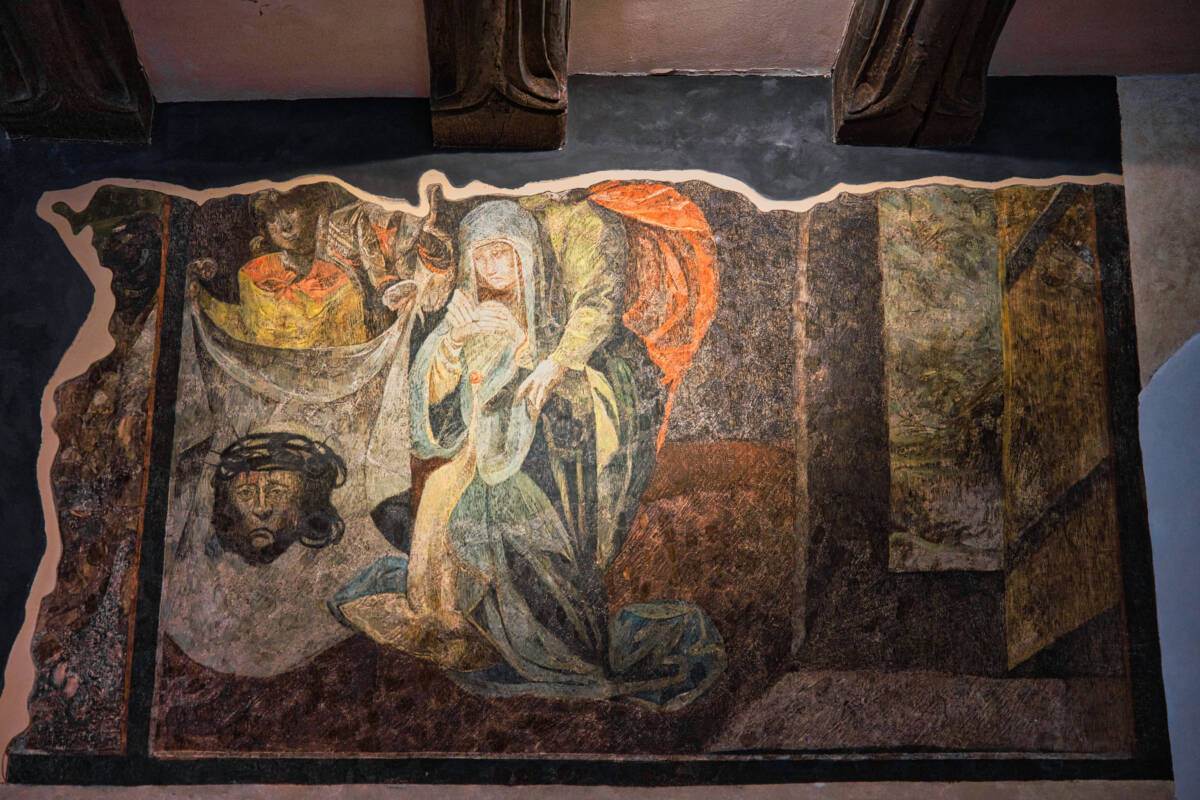
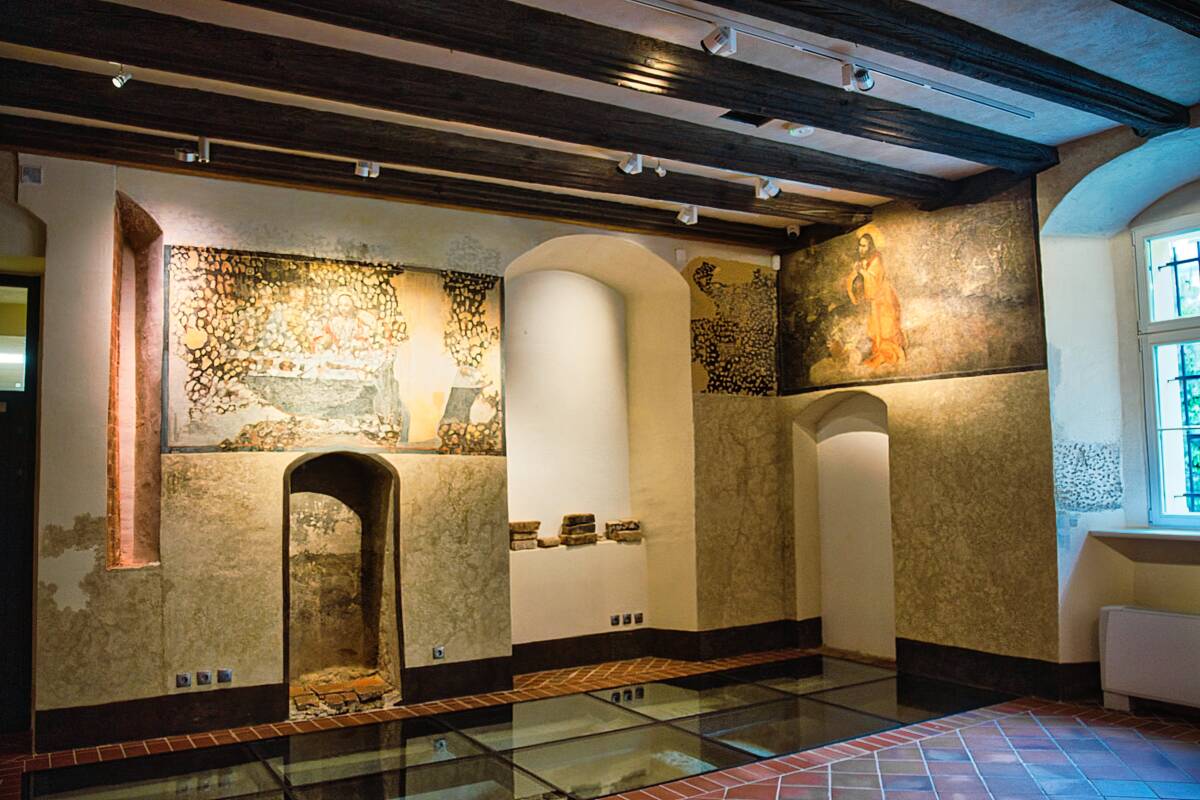
For decades, the secrets within the walls of the former refectory remained hidden beneath layers of plaster and paint. As it turned out, the interior had been covered with Mannerist polychromes depicting the Passion of Christ. The continuous composition runs in a frieze-like band along the upper part of the walls, featuring distinct scenes that begin with the Last Supper. The paintings were executed using the egg tempera technique on a tinted lime wash applied over the plaster. The stylistic features and color palette point to a strong influence of Northern European painting and graphic arts, drawing on both modern-era and late-Gothic models. Pinpointing their exact origin was aided by the year 1616, which is engraved inside a cartouche on the central ceiling beam. Given that the Poor Clares moved into their newly built convent in 1618, the creation of the paintings can be confidently dated to the years 1616–1618.
The initial sections of the paintings were identified by the staff of the MOB Conservation Department during the structural supervision of the building's renovation in early May 2018. Upon gaining access to the walls, the museum conservators gradually removed all secondary plaster layers, successfully identifying most of the uncovered scenes, starting with the Last Supper. It was also during this time that bricked-up niches and window embrasures (glyphs) were located in the north and east walls, along with the original entrance to the refectory.
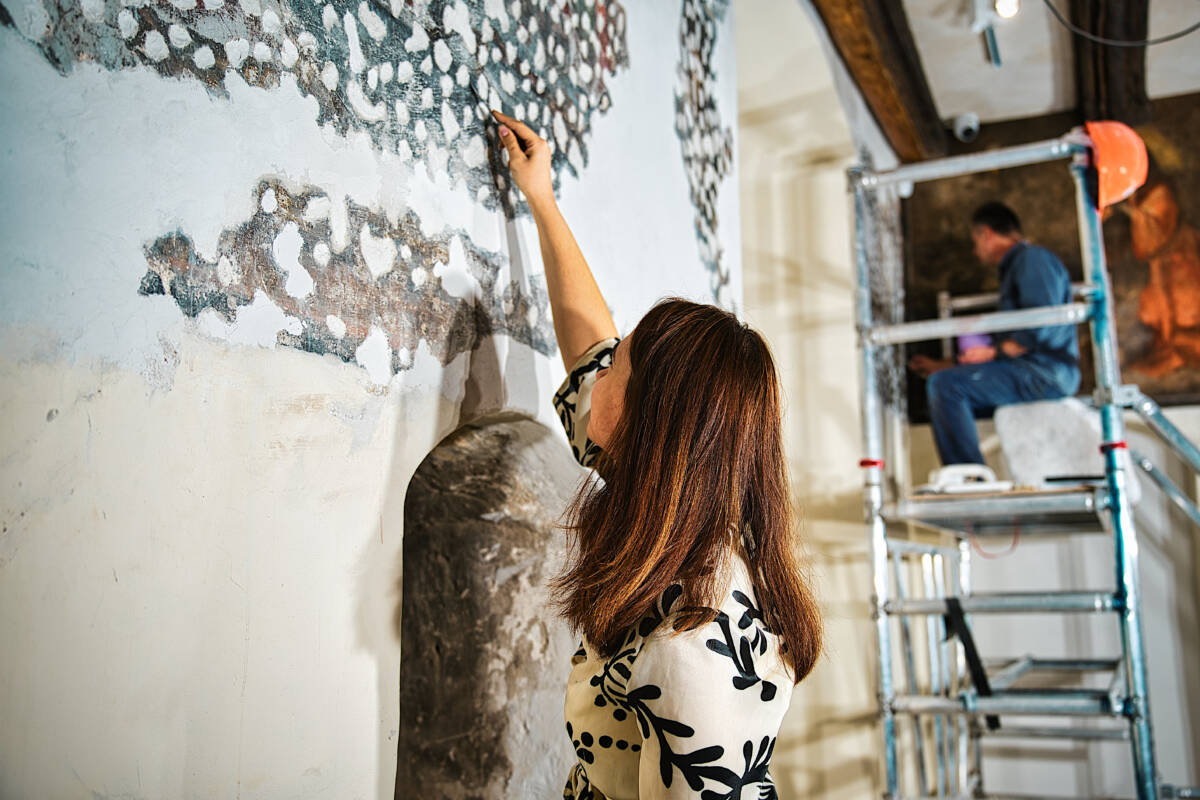
The paintings suffered severe damage during the partition period. In the 1860s and 1870s, significant remodeling and expansion work was carried out on the building. The pre-existing cloisters—which served as passageways between the former convent and the church—were demolished. To accommodate its new functions, the refectory space was remodeled, including the installation of partition walls. The original plaster was partially chipped away, and some sections were heavily damaged by a dense network of hammer peck-marks designed to help the new layer of plaster adhere. During this reconstruction, the round-arched niches, a fireplace, and the exit leading to the monastery courtyard (viridarium) or cloister were also bricked up. Furthermore, three segmental-arched doorways were cut into the north wall to connect it with the adjacent wing. These works resulted in the irreversible loss of several paintings, particularly in the western section, and caused near-catastrophic destruction to the remaining parts.
From 2019 to 2025, extensive conservation efforts were carried out, focusing on layer consolidation, surface cleaning, repairing mortar losses, restoring paint layers, and conducting essential research. In April 2021—almost exactly 12 years after the building had been closed to the public—the Museum's guests had their first opportunity to see the initial results of the conservation and expansion project. The refectory was officially opened to visitors on June 5, 2025. Iconographic research is still ongoing, and further conservation work will be guided by its findings. The wall paintings in the former refectory hall remain a true rarity, not only regionally but on a national scale across Poland.
Depictions
East Wall:
- The Last Supper
- Unidentified scene
South Wall:
- Christ in the Garden of Gethsemane (lub krócej: The Agony in the Garden)
- The Kiss of Judas (lub The Betrayal of Christ)
- Christ before Herod
- Scene entirely destroyed
West Wall:
- Scene entirely destroyed
- Christ before Caiaphas
- Christ before Pilate
North Wall:
- Fragment of an unidentified scene featuring a soldier
- Pilate washing his hands as Christ is led out of the Praetorium
- Fragments of the scene: Christ falling under the Cross
- The Group of Mary, St. Veronica, and St. John
- Two small fragments of an unidentified scene, presumably the Crucifixion
East Wall (continued):
- Scene entirely destroyed due to the cutting of a new window opening to the left of the Last Supper
Sala dawnego refektarza - Muzeum Okręgowe - Bydgoszcz - fot. Błażej Witkowski
Conservation Team
- MOB Conservators: Lesław Cześnik, Magdalena Gapińska, Piotr Kopciewicz, Joanna Truszkowska
- Master’s Students from the Faculty of Fine Arts at Nicolaus Copernicus University (UMK) in Toruń: Kamila Bucior, Maria Juszkiewicz, Dominika Piekarska – under the supervision of Prof. Robert Rogal, PhD, DSc, and Lesław Cześnik (2019–2021)
- Marta Walasek (2025): Conservation works on the scene Pilate Washing His Hands
- Plastering Works: Rusłan Dik, Rimma Vasylieva, Serhij Novakov
- Consultants: Prof. Robert Rogal, PhD, DSc; Prof. Jacek Tylicki, PhD, DSc; Sebastian Dudzik, PhD
- Historical and Architectural Research: Prof. Joanna Kucharzewska (NCU), Piotr Dąbrowski
- Historical Outline: Kamil Ściesiński
- Text: Lesław Cześnik, Kamil Ściesiński
When?
Permanent exhibition (please check the museum opening hours)
Where?
The Leon Wyczółkowski District Museum in Bydgoszcz
4 Gdańska Street, Bydgoszcz, Poland